

Solutions › Napier grass · CBG
Compressed Biogas · Feedstock Strategy
Napier Grass looks almost perfect for CBG: high yields per hectare, fast growth, multiple harvests, good methane potential — and, today, still attractive feedstock costs in many regions. The opportunity is real. But before you build a CBG plant around it, one question matters more than any other: what happens when the conditions change? What happens when the price changes?
High yields per hectare · Fast growth · Multiple harvests · Good methane potential
You're building for 20 years — not for the next harvest
Grow it. Harvest it. Feed it into the plant. Produce CBG. Sell CBG. Make money. When a market is growing fast, nobody wants to miss the opportunity. But a CBG plant isn’t an investment you can easily reverse. Once the CAPEX is spent, your plant has to perform — every day, for decades.
That means your real investment isn’t just the digester. It’s the entire feedstock system behind it: cultivation, harvesting, transport, storage, feeding and biology — over 20 years. The decisive question was never whether Napier Grass is digestible. It is.
The question is whether that whole chain stays economical for decades. We have been working in biogas for more than three decades — and if there is one thing we know, it is this: conditions always change.
Proof, not promises
See a Snow Leopard reference plant that has now run for more than two decades — through changing feedstock markets, changing regulation and changing economics. That’s the horizon we design for. (Reference plant video to follow.)
You're not paying only for biomass
Fresh Napier Grass contains a lot of water — around 750 kg per tonne. Three quarters of what you transport is water. That sounds harmless — but water doesn’t produce methane. You still have to harvest it, transport it, store it, pump it, heat it, move it through the plant, and handle much of that water again in the digestate. The feedstock that looked cheap in the feasibility study can become far more expensive in real operation.
The number that looks good on paper
Two feedstocks can have the same energy potential but very different water content
The wetter one needs more transport volume across the countryside
More storage, more handling capacity, potentially more digester volume
And more digestate to manage afterwards
Every unnecessary tonne, cubic metre and kilowatt-hour costs money
But higher TS isn’t automatically better: if the grass is already strongly lignified, the methane yield drops
The number that actually decides
We assess cost per tonne of dry matter
And cost per tonne of organic dry matter
And, ultimately, cost per cubic metre of methane
That’s the number that carries a 20-year investment
Cheap-per-tonne and cheap-per-m³-methane are rarely the same thing
Grass doesn't wait for your business plan
None of these mean Napier Grass is a bad feedstock. They mean a commercial CBG plant cannot demand — or rely on — perfect grass every day for 20 years — and its process has to cope when reality gets in the way.
💧
The longer the transport distance, the more water you move. The longer fresh grass waits, the more it warms up, loses plant juice and deteriorates before it enters the process.
🌾
Low dry-matter grass is hard to ensile. Too wet, and leachate forms — lost organic matter, extra infrastructure, and aggressive organic acids attacking surfaces if the store is wrongly designed.
🪵
Wait longer for more dry matter and the plant lignifies. Lignocellulosic structures get harder for microbes to access, so degradation slows and the theoretical energy potential isn’t fully realised.
🔗
The biggest risk of all. Cheap today — but what happens when farmers realise your multi-million plant can’t run without them, demand rises, a harvest fails, or transport costs climb?
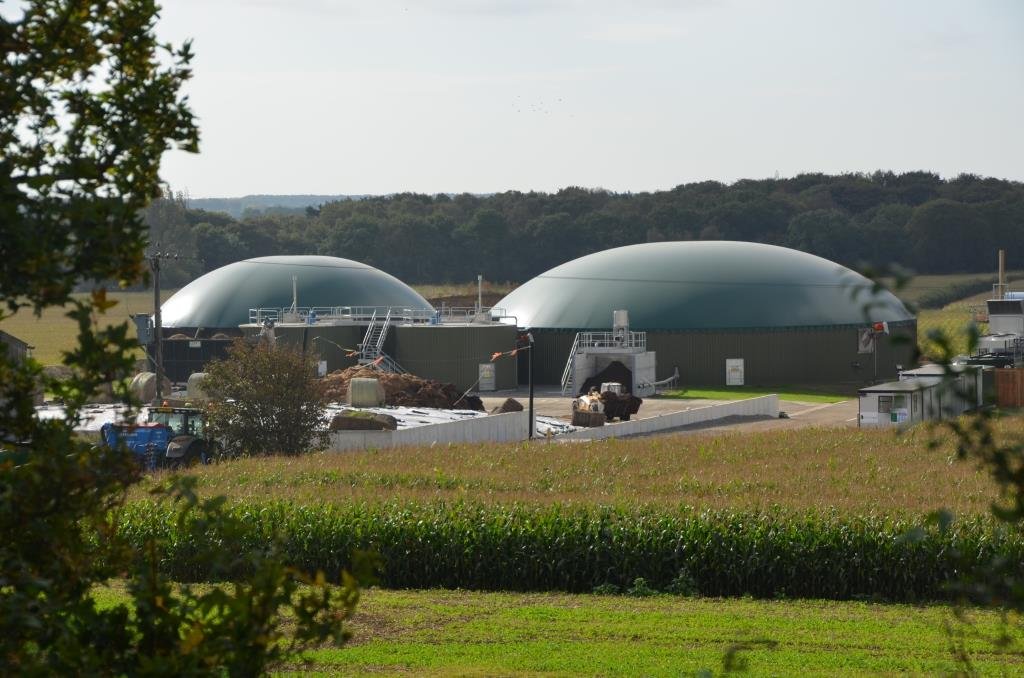
Germany has seen this before
For many projects, maize was an excellent feedstock. Then the conditions changed — feedstock costs rose, competition for agricultural land grew, regulation shifted, margins tightened. The cheapest feedstock can become very expensive the moment everyone knows you have no alternative.
Thinking that conditions won’t change is naive.
The pivot
Use Napier Grass when it makes economic sense. Use a lot of it if the economics are attractive. But don’t make your entire investment depend on it. Our plant concept is designed to handle different dry-matter contents, different fibre structures, different feedstock combinations and alternative agricultural residues. Your plant should adapt to the feedstock market — not the other way around.
Flexibility gives you security.
Our process starts as soon as the truck arrives
Fresh Napier Grass shouldn’t sit for hours in a hopper, warming up and losing valuable organic matter. The bigger the hopper, the higher the loss. Each step gets the conditions it needs — the goal is simpler, more stable operation, not more complicated technology.
01
The process takes Napier Grass in without unnecessary intermediate storage — before it warms up and loses organic substance.
02
Built to process varying dry-matter contents of roughly 20–30% TS, depending on the project-specific feedstock and design.
03
Around 48 hours of feeding buffer means the plant doesn’t depend on trucks arriving every few hours — security for weekends and holidays.
04
A dedicated hydrolysis and preparation stage gives another level of process control before the material reaches methane production.
05
Only then does the main methane-producing stage take over — separated from preparation, not forced to do everything at once.
Why two stages? Because fresh, easy-to-digest biomass and increasingly fibrous biomass don’t behave identically. Instead of expecting one digester to solve every biological task at the same time, we separate them: hydrolysis and preparation first, methane production afterwards. That gives us significantly more flexibility when feedstock properties change.
Your backup is already lying in the fields

A storable option that keeps for long periods
A locally available residue, already in the region
No cultivation specifically for your biogas plant
Independent of one crop, one harvest, one supplier
Options are what carry a 20-year investment
Napier Grass prices double? You can react.
A farmer consortium changes its terms? You can react.
A drought affects production? You can react.
A sugar mill offers an attractive residue stream? You can use it.
Your plant isn’t locked into yesterday’s business plan.
A plant earns money when it runs
8,000+ hours
Your financing doesn’t get cheaper when the digester sits idle. Your depreciation doesn’t stop. Your fixed staff costs don’t disappear. The closer you get to continuous full load, the more CBG you produce from CAPEX you’ve already invested — which is why feedstock flexibility feeds directly into profitability: more available feedstock, more operating hours, more CBG, more revenue from the same investment.
We have already achieved 8,736 full-load hours in practice.
Feedstock Freedom is financial freedom
And Napier Grass and paddy straw are far from the end of the list. There are many more feedstocks available than most investors think. We have a list of 57 different feedstocks we have already digested — and we can digest many more.
More hours
More operating hours across the year
More CBG
More tonnes produced against the same fixed costs
More revenue
Production you would otherwise lose forever
Less risk
A plant that can react instead of standing still
We know what early biogas markets feel like
SLP was building and operating biogas plants when the German market was still young — the excitement, the rapid growth, the new suppliers, the belief that certain conditions would last forever. They didn’t. More than 30 years later, we’re still here. Across 57 feedstocks and 750+ energy-efficiency projects, we’ve seen successful plants — and expensive mistakes. That’s experience you can’t download from a brochure.
30+
years of biogas experience
57
different feedstocks handled — crops, manure, straw, residues
750+
biogas energy-efficiency projects
20 yrs
the horizon we design every plant for
Let's talk about your Napier Grass strategy
Before you invest millions into a CBG plant designed around a single crop, talk to us. We’ll look at your Napier Grass supply, harvesting concept, transport distances, storage strategy, dry-matter variation, alternative feedstocks and long-term plant design. Napier Grass may be an excellent basis for your project — build a plant that gives you choices.
Or directly: +49 8734 939770 · info@snow-leopard-projects.com
Practical knowledge, funding programmes and news from Snow Leopard Projects — compact by email.